
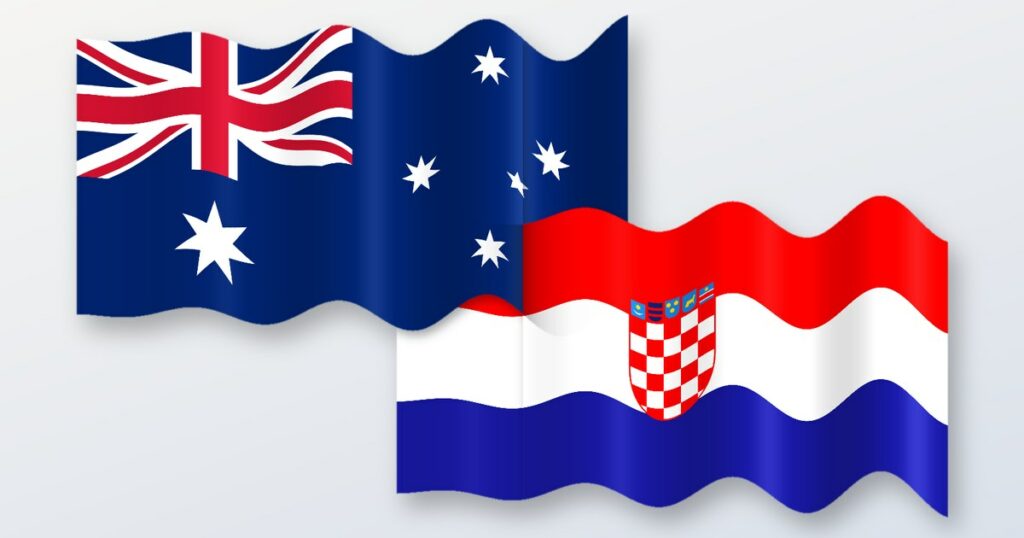
Australia has one of the largest Croatian communities outside Europe. In the 2021 Census, 164,362 people in Australia reported Croatian ancestry, and 43,302 Australian residents were born in Croatia. Many of them, along with their children and grandchildren, do not realise that they may be entitled to Croatian citizenship. It brings an EU passport, the right to live and work anywhere in the European Union and a formal link to the homeland of their family.
This guide explains who can apply, where the ancestors of Croatian Australians came from and why this matters legally. It also explains how to deal with the surname differences that appear in almost every Croatian Australian family and how the application process works in Australia.
Who can obtain Croatian citizenship from Australia?
Croatian citizenship is governed by the Zakon o hrvatskom državljanstvu (ZHD). For Australians of Croatian origin there are four main routes, and which one applies to you depends on your family history.
1. You may already be a Croatian citizen
Some people of Croatian origin born in Australia are already Croatian citizens without knowing it. Under Article 4 ZHD, a child whose parents were both Croatian citizens at the time of the child’s birth acquires Croatian citizenship by origin. In that case naturalisation is not needed, and registration in the register of Croatian citizens is sufficient.
If only one parent was a Croatian citizen and you were born in Australia, under Article 5 ZHD you acquired Croatian citizenship by origin if you were registered with a Croatian diplomatic mission, consulate or registry office before turning 21 for entry in the register of Croatian citizens. A temporary option for people over 21 was available for three years after the amendments of 1 January 2020, but that deadline has expired. If you missed the age limit, your route is usually the one for descendants of emigrants, described below.
2. Descendants of Croatian emigrants (Article 11 ZHD)
This is the most important route for Croatian Australians. Under Article 11 ZHD, an emigrant and their descendants can acquire Croatian citizenship by naturalisation under significantly relaxed conditions. They do not have to renounce their Australian citizenship, do not need to live in Croatia and do not take the Croatian language and culture test. The law speaks of “descendants” without limiting the number of generations, so grandchildren and great-grandchildren of emigrants may also qualify.
An emigrant is a person who, before 8 October 1991, emigrated from the territory of the Republic of Croatia with the intention of living abroad permanently. By way of exception, a member of the Croatian people who emigrated from the territory of former states that also included the territory of today’s Croatia, such as Austria-Hungary or Yugoslavia, is also considered an emigrant. This is particularly important for Croats from Bosnia and Herzegovina. In that case, the Croatian missions in Australia state that the applicant must also prove the date of emigration (before 8 October 1991) and membership of the Croatian people.
The ZHD also lists cases that are not considered emigration. A person who moved to another republic of the former Yugoslavia, or who did not hold Croatian republic citizenship or zavičajnost in Croatia, is not considered an emigrant. If your family first moved from Croatia to another part of Yugoslavia and only then to Australia, this requires careful legal assessment.
3. Members of the Croatian people (Article 16 ZHD)
A member of the Croatian people who does not live in Croatia can acquire Croatian citizenship if they respect the Croatian legal order, have no outstanding public charges and there are no security obstacles. Membership of the Croatian people must be proven, for example with documents showing that you previously declared yourself Croatian in legal transactions, such as employment, military, student or civil registry records. Evidence may also include protecting the rights and promoting the interests of the Croatian people, or active participation in Croatian cultural, scientific or sports associations abroad. Croatian clubs, churches and sports associations in Australia can therefore be an important source of evidence.
4. Spouses
A foreign national married to an emigrant or a descendant of an emigrant can also acquire Croatian citizenship under the same relaxed conditions (Article 11(2) ZHD). This means that an Australian spouse without Croatian roots can apply together with their partner.
What about dual citizenship?
Australia permits dual citizenship, and none of the routes described requires you to renounce your Australian citizenship. However, under Article 2 ZHD, a Croatian citizen who also holds a foreign citizenship is considered exclusively a Croatian citizen before Croatian authorities. In practice this matters mainly when dealing with Croatian institutions in Croatia, for example when entering or leaving the country.
Where did Croatian Australians come from?
When and where your ancestors left is not just family history. It is the core of an application under Article 11 ZHD, because you must prove that your ancestor emigrated specifically from the territory of today’s Croatia.
The first wave: Dalmatians and the gold rush
The gold rush in Western Australia in the 1890s started significant emigration of Croats, mainly from Dalmatia. By the early 20th century, around 2,000 to 3,000 people of Croatian origin lived in Australia, 80% of them in Western Australia. Dalmatians did not go only to the goldfields. In the late 19th century, a number of Croats from the Dalmatian islands arrived in South Australia, where many found work in Port Pirie and Broken Hill.
The reasons for leaving were mainly economic. Dalmatia lived from wine, and historians name the “wine clause” and phylloxera as two key causes of emigration from the region in the 19th century. Even in the late 1940s the community had a clear regional profile: in 1947 at least 5,000 Croats lived in Australia, mostly from Dalmatia, particularly from the Makarska area and the island of Korčula.
After the Second World War
The post-war period brought a different kind of emigrant. From 1945 to 1952, Australia’s post-war immigration programme accepted around 170,000 displaced persons from Eastern Europe, including Croats. Many of them left Yugoslavia for political reasons, often illegally, which can make it harder to document their departure.
The largest wave: the 1960s and early 1970s
The largest group arrived later. Research on Croats in Western Australia describes the period from the 1960s to the early 1970s as the largest wave of Croats to reach Australia. It also notes that most emigrants of the 1960s were of rural origin, with little formal education and limited English. In South Australia, this generation emigrated for economic reasons and to escape ethnic and political conflict in Yugoslavia. In this period, Croats came not only from Croatia but also from Bosnia and Herzegovina. A smaller wave followed in the late 1980s and early 1990s.
Why “Yugoslav” or “Austrian” on old documents is not a problem
Australian records rarely say “Croatia”. The first emigrants left Austria-Hungary, and later ones travelled on Yugoslav passports. Local histories from Western Australia record that most Croatian settlers in Western Australia considered themselves Yugoslavs at the time of their arrival. Croatian law looks at substance, not labels. What matters is where your ancestor actually lived and from which territory they left, not what nationality an Australian official wrote on a form.
Surname problems: Kovačević, Kovacevic or Kovacevich?
Surname differences are probably the most common practical problem in applications from Croatian Australians. The Croatian alphabet has the letters č, ć, š, ž and đ, which disappeared from most Australian records. Kovačević became Kovacevic, and many older families adopted the “-ich” ending common in English-speaking countries. A well-known example is Tom Starcevich, a Croatian Australian born in Subiaco, Western Australia, who received the Victoria Cross for bravery in the Second World War. In Croatian, his surname would be written Starčević.
First names changed too. Ivan often became John, Ante became Tony and Mate became Matthew. Some families changed their surname officially, by a change of name document or at naturalisation, while others simply had it misspelled by officials.
This matters because the Croatian authorities require that the name, surname, place and date of birth match in all documents. If your grandfather is recorded in a Croatian register as “Ante Kovačević” and on his Australian naturalisation certificate as “Tony Kovacevich”, you must prove that this is the same person. The following documents are useful:
- Naturalisation records: The National Archives of Australia holds Commonwealth naturalisation records. The Department of Immigration Citizenship Index, available at all offices of the Archives, lists all successful applicants for naturalisation in Australia since 1904. The Archives recommend including any known alias or alternate spelling of the name when searching. For earlier periods, naturalisation records for Queensland, New South Wales, Tasmania and Western Australia are held in the archives of those states.
- Change of name certificates: These are issued by the registry of births, deaths and marriages in each state or territory.
- Marriage certificates: These often contain the spouse’s original name and place of birth.
- Migrant selection records and passenger lists: The National Archives also holds migrant selection documents from 1945.
In your Croatian biography you can briefly explain how and when the surname changed. A clear and documented sequence of names saves months of correspondence with the Ministry.
How to apply for Croatian citizenship in Australia: Step by step
Step 1: Find the competent mission
The application is submitted in Australia, not in Croatia. The competent office depends on where you live: ACT belongs to the Embassy in Canberra, VIC, SA and TAS to the Consulate General in Melbourne, NSW, QLD and NT to the Consulate General in Sydney, and WA to the Consulate in Perth.
Step 2: Book an appointment
Appointments are booked by email or phone, because the application must be submitted in person at a diplomatic mission or consular office.
Step 3: Gather the documents
The core documents for an adult applicant include, for example:
- a valid Australian passport or another valid passport,
- a biography and motivation letter in Croatian,
- a birth certificate with an apostille, not older than 6 months and translated into Croatian,
- a marriage certificate, where applicable, under the same conditions,
- a criminal record check not older than 6 months from the country of which you are a citizen and/or in which you have permanent residence, with an apostille and translated into Croatian,
- other documents depending on the legal ground of application
The biography should contain your personal details, education, employment, your parents’ names and their birth details and, where applicable, your parents’ emigration path.
For descendants of emigrants, the chain of evidence is key: emigrants must submit documents showing that they left Croatian territory, and descendants must prove their kinship with the emigrant. In practice, this means birth and marriage certificates for every generation, from the emigrant to you.
Step 4: Apostille and translation
Australian documents must be certified with an apostille. The Department of Foreign Affairs and Trade (DFAT) is the only Australian government body that issues apostilles. DFAT can only certify originals issued by Australian government bodies or officials, originals from Australian higher education institutions, and copies certified by an Australian notary public. The fee is currently 102 Australian dollars per apostille.
After the apostille, documents in English must be translated into Croatian by a certified translator, and the consulate refers applicants to NAATI for certified translators. The originals of all documents must also be presented.
Step 5: Submit the application and pay the fee
You submit the application in person and pay the consular fee. The amount of the fee is reviewed every year, and the fee is not refunded, regardless of the outcome of the application.
Step 6: Processing and the decision
The consulate only receives the application, and the decision is made by the Ministry of the Interior of the Republic of Croatia. For a complete application, processing takes approximately 12 to 24 months, although individual cases vary. If your name or contact details change during this period, you must notify the consulate so that the application can be updated.
If the decision is positive, citizenship is acquired on the day the positive decision is delivered. You are then entered in the register of citizens and attend a citizenship ceremony at the consular office. After that, you can apply for a Croatian passport and identity card.
Common mistakes to avoid
Most delays and refusals result from a few problems that can be avoided:
- Out-of-date documents: Birth and marriage certificates and criminal record checks must not be older than six months at the time of submission, so the order of apostilles and translations needs careful planning.
- Unexplained differences in names between Croatian and Australian records.
- Proving the wrong fact: Applicants often prove that their ancestor was Croatian, but not that they emigrated from the territory of today’s Croatia.
- Overlooking a move within Yugoslavia: Families who moved within Yugoslavia before leaving for Australia may not meet the definition of an emigrant.
- Applying on the wrong legal ground: Some applicants apply as descendants of emigrants when they are already citizens by origin, or the other way round.
Final thoughts
For many Croatian Australians and their descendants, Croatian citizenship is not a distant possibility but a right the law already recognises. Some may already be Croatian citizens and only need to be entered in the register. Others can acquire it as descendants of emigrants, members of the Croatian people or spouses, without renouncing Australian citizenship, without moving to Croatia and without a language test.
However, the success of an application does not depend on whether you feel Croatian, but on whether you can prove it. What matters is choosing the right legal ground, documenting your ancestor’s emigration from the territory of today’s Croatia, building an unbroken chain of civil records from the emigrant to you, and clearly explaining any differences in names and surnames. These are exactly the points where applications most often get stuck, and the mistake is usually discovered only after many months of waiting.
That is why it pays to start with your family history, not the application form. Find out when and where your ancestor left, how they were recorded in Croatian registers and how in Australian documents, and only then choose your route. With good preparation, a Croatian citizenship application turns from a bureaucratic hurdle into a story that reconnects your family with Croatia, this time officially.